If you’ve ever stood in front of a networking rack, staring at a bundle of thin fiber cables that seem to crisscross every which way, you know the hidden workhorses behind smooth, high-speed connectivity are the connectors. As someone who’s been in the fiber optic cable hardware supply game for over a decade, I’ve lost count of how many times customers walk into our shop or message us asking, “Which connector is actually best for my network?” The answer isn’t one-size-fits-all—no amount of glossy marketing can make a single connector work for a data center’s 400G backbone, a small business’s office LAN, or a field tech’s quick fiber repair job. Let’s break this down like we’re chatting over a coffee, no jargon overload, just real-world lessons from years of supplying hardware to everything from 10-person startups to 500,000-square-foot warehouses. Fiber Optic Cable Hardware
First, let’s ground this in what a fiber connector actually does, because skipping that means chasing specs that don’t matter. Unlike electrical connectors, which rely on metal pins to carry current, fiber connectors align two tiny glass (or plastic) cores so light can pass between them with almost zero loss. Every tiny misalignment—even a micron’s worth, or a smudge on a ferrule (the ceramic plug that holds the core)—adds up to signal loss that translates to dropped calls, slow file transfers, or full network outages. That’s why durability, ease of termination, and compatibility with your specific network speed matter more than just picking the “most popular” connector.
Let’s start with the workhorse that’s probably been in your network for longer than you’ve had your current laptop: the SC connector. Short for Subscriber Connector (or sometimes Standard Connector, for the less formal crew), the SC was invented back in the 1980s by Bell Labs, and it’s still the most supplied connector in our inventory for a reason. It’s a square, push-pull design—you push it in to click, pull a small tab to release—so it’s impossible to plug in backwards, a huge win for techs who’ve spent 20 minutes untangling cables just to realize they had a connector flipped the wrong way. For multimode fiber (the stuff used in LANs, building-to-building links up to 550 meters at 10Gbps) and single-mode fiber (for long-haul links, up to 10 kilometers at 10Gbps or more), SC connectors are workhorses. We supply millions of these a year for small to mid-sized businesses, and the feedback is consistent: they’re tough, easy to terminate with basic tools, and cheap enough that replacing a dozen after a rack reconfiguration doesn’t break the budget. The only downside? It’s bulkier than newer designs, so data centers with tight, packed racks often skip it in favor of smaller connectors.
Which brings us to the LC connector, the one that’s taken over data centers in the last 15 years. Short for Lucent Connector (named for Bell Labs’ spinoff), the LC is half the size of an SC, using a snap-on latching mechanism similar to a RJ45 Ethernet plug. That small size is a game-changer: a single 1U rack panel can hold 48 LC connectors, compared to just 24 SCs, so you get twice the density in the same space. That’s why when we supply hardware for hyperscale data centers or cloud providers, 90% of the orders are LC. They’re also durable enough for high-speed networks up to 400Gbps, which is critical now that most enterprise networks are moving past 10Gbps links. But wait—here’s a real lesson I’ve learned: LC connectors are easy to damage if you’re not careful. The latching tab is small, so it can snap off if you yank a cable too hard during a rack rework, and the tiny ferrule means even a small smudge from a dusty glove can cause more signal loss than an SC. For field repairs or non-technical teams? LC is doable, but you need to train your crew to handle them gently. We always throw in free cleaning swabs with LC orders for that exact reason.
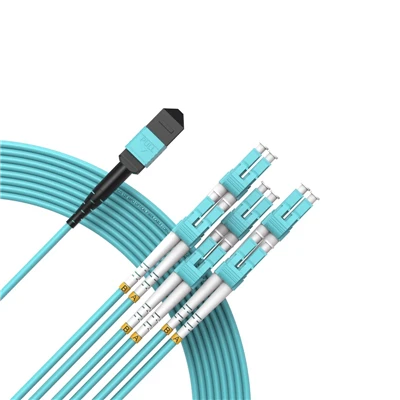
Now, if you’re working with very high-speed, short-reach links—like within a single server rack or a high-density data center patch panel—you’ll run into MTP/MPO connectors. These aren’t single-fiber connectors; they’re 12-fiber or 24-fiber “fan-out” connectors that let you connect dozens of fibers in one plug. Before MTP/MPO, techs had to terminate each single fiber individually, which meant 12 plugs for a single link—tedious, slow, and prone to misalignment. Now, one MTP/MPO connector does the job. Most of the MTP/MPO work we do is for 40G and 100G networks, where single-fiber connectors would be too slow to deploy and take up too much space. There’s a difference between MPO and MTP, by the way: MTP is a patented, higher-precision version of MPO that has tighter tolerances, so it has less signal loss. We always advise customers that if their network is running at 100G or above, splurge on MTP instead of basic MPO. The cost difference is minimal, but the signal consistency makes all the difference in avoiding those sudden, frustrating outages during peak traffic.
Then there are the connectors for specialized jobs, because not every network is a 100G data center. If you’re doing outdoor installations—like laying fiber between two buildings across a parking lot—you need something that can take UV rays, temperature swings, and accidental tugs. The ST connector (Straight Tip, also called Bayonet Connector) is the classic outdoor choice. It’s a round, twist-and-lock design, so it’s more secure than push-pull connectors that can work loose if jostled by wind or construction equipment. For years, ST was the go-to for campus networks, and we still supply a lot of them for rural telecom providers who need connectors that can handle rough field conditions. The tradeoff? They’re larger, lower density, and not ideal for high-speed networks above 10Gbps, so they’re mostly for legacy or outdoor use cases.
And let’s not forget the little guys: simplex vs. duplex connectors. A simplex connector is a single fiber, used for one-way links (like from a router to a server that only needs transmit), while duplex has two fibers, for transmit and receive, which is what most point-to-point links use. The good news is most modern connectors (LC, SC, ST) come in both simplex and duplex versions, so you don’t have to mix and match.
Now, here’s the part no marketing sheet will tell you: the “best” connector is almost always tied to three things: your network’s speed, your installation environment, and how often you need to rework or move cables. If you’re a small business with a 10Gbps LAN in a single office, SC connectors are more than enough—cheap, easy to install, and forgiving of small mistakes. If you’re a mid-sized data center expanding to 400G, LC connectors give you the density you need. If you’re laying fiber across a highway for a cellular tower, ST’s twist-lock design is worth the extra size. If you’re wiring a server rack for 100G, MTP/MPO cuts your installation time by half.
I’ve seen customers make the wrong choice more times than I can count. A startup came to us a few years back, tried to install LC connectors in their small office, and their part-time IT team kept breaking the latching tabs during moves. They switched to SC, cut their connector failure rate by 80%, and saved hundreds of dollars in replacement parts. Another customer, a telecom provider doing outdoor fiber runs, tried to use LC connectors for a new campus link, and after six months, wind and small equipment tugs had loosened half the plugs. Switched to ST, and those links have run flawlessly for three years. These aren’t edge cases—they’re real, everyday problems that come from picking a connector for the specs instead of your actual use case.
As a supplier, our job isn’t just to sell connectors—it’s to help you pick the right one. We’ve been in this space long enough to know that every network is unique, and there’s no one-size-fits-all answer. Whether you’re planning a new office LAN, expanding a data center, doing outdoor fiber runs, or repairing a damaged cable in the field, we can help you navigate the options, pick connectors that fit your budget and performance needs, and even provide on-site tech support for terminations if you need it.

If you’re gearing up for a network project, whether it’s a small upgrade or a full fiber installation, don’t settle for generic advice. Reach out to our team, share your network speed, installation environment, and any challenges you’re facing, and we’ll help you find the connector that will keep your network running smooth, now and for years to come.
MPO/MTP Multimode Fiber Cable References
- International Electrotechnical Commission. (2022). Fiber optic connector specifications for local area networks. IEC 61754-13.
- Telecommunications Industry Association. (2021). Performance standards for fiber optic connectors in data centers. TIA-568-C.3.
- Lucent Technologies. (1996). LC Connector Design and Performance for High-Density Fiber Applications. Internal Technical Report.
- Bell Labs. (1987). SC Connector: A Low-Loss, High-Reliability Fiber Optic Connection Solution. AT&T Technical Journal.
Shenzhen Dimi Telecommunications Co., Ltd.
As one of the most professional fiber optic cable hardware manufacturers and suppliers in China, our products have good reputation in the market. Please rest assured to wholesale advanced fiber optic cable hardware made in China here from our factory. Also, custom service is available.
Address: China
E-mail: sales@dimifiber.com
WebSite: https://www.dimi-fiber.com/
